


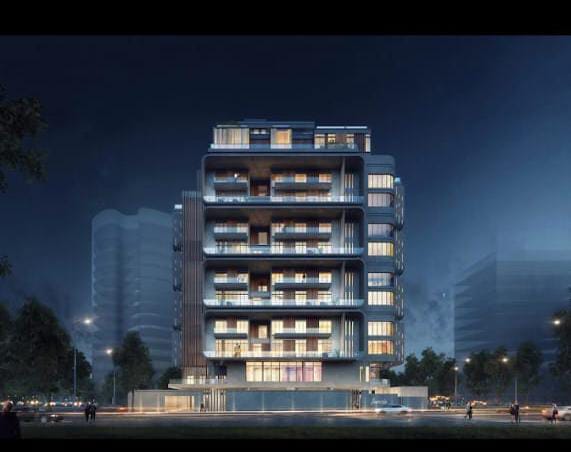

The weight of ambition is heavier than capital.

It is in the years of discipline, conviction, and relentless focus that a builder is truly
tested—years when partners grow impatient, investors demand answers, and a vision once
praised as audacious is quietly rebranded as reckless. It is the quiet humiliation of delays, the
legal battles that drain both time and spirit, and the public scrutiny that questions your name
long before your work is complete.
Not every great structure is born from ease. Some are shaped by waiting, by wounds that
must first heal, and by a quiet determination to rise again when giving up feels justified. Lucrezia
by Sujimoto is one such story—a project that demanded more than capital and concrete. It
demanded endurance.
At first, it was only a simple vision—one burdened with the kind of ambition that rarely survives
recessions, forex volatility, or the slow erosion of doubt. This was never about adding another
address in Banana Island’s most expensive enclave. It was about challenging quiet
assumptions and confronting a harder question: could a Nigerian developer build something
refined enough to stand beside the world’s finest, without apology?
In boardrooms where banks measured only risk, the answer was almost always the same: “No.”
Each rejection became a reminder that capital can be negotiated, but conviction must be
earned. And in the silence that followed, the vision only grew sharper.
At the center of that stubborn conviction stood Dr. Sijibomi Ogundele, the visionary founder and
Group Managing Director of Sujimoto Holdings. For him, Lucrezia was never a line item on a
balance sheet; it was a statement of purpose. He believed Africa deserved structures bold
enough to stand beside the world’s finest, not behind them. Where others saw excessive
risk, he saw opportunity. Where compromise was advised, he chose responsibility.
Lucrezia was not born from convenience, but from lineage. Its inspiration reaches back to the
Italian Renaissance, to the grace and quiet authority associated with Lucrezia de’ Medici—an
era when buildings were not merely constructed, but commissioned as expressions of taste,
power, and permanence. The tower’s sculpted curves, disciplined proportions, and restrained
detailing follow that same aristocratic logic. In a district defined by luxury, Lucrezia was never
meant to compete for attention; it was meant to command it—efortlessly, like a crown that never
needs to announce its worth.That philosophy found its most visible expression in the façade. Rather than conventional
finishes, Sujimoto commissioned Nigeria’s first-of-its-kind exterior using Spanish-engineered
Glass Reinforced Concrete (GRC)—a material more commonly associated with the world’s most
refined architectural landmarks. It was a demanding choice, rarely attempted at this scale in
Nigeria, but one that allowed the tower’s signature curves to be executed with the precision and
elegance the design required.
What many once called impossible now rises 15 storeys above Banana Island. Lucrezia
stands as the enclave’s tallest and most luxurious residential tower—just two months away from
completion and key handover to homeowners who chose patience over doubt.
But the road to that moment was anything but merciful. By 2020, the ambition collided with an
economic reality few developments could survive. The pandemic shut ports, fractured supply
chains, and distorted construction costs beyond recognition. Materials that once moved with
predictable precision became trapped in uncertainty. Containers of luxury finishes sat in
bureaucratic gridlock, while the cost of clearing a single 40-foot container surged from
₦4 million to ₦24 million. The quiet arithmetic of the project grew increasingly unforgiving.
What began as an architectural statement was suddenly a test of financial endurance.
“Any developer with a parcel of land and a cement mixer can assemble a block of flats. Lucrezia
was never meant for that. It was conceived as an iconic structure—a monument Lucrezia de’
Medici herself might have commissioned: curved, complex, and utterly uncompromising in its
pursuit of excellence,” Dr. Ogundele asserted.
Scars, Success, and Investment
In building Lucrezia, every floor came at a cost. Delays were predicted. Compromises were
recommended. Quiet abandonment was expected. Instead, the structure kept rising.
Post-tensioned slabs—an engineering approach more common in the Middle East’s tallest
towers—became part of its structural DNA, signaling a subtle but important shift: Lagos would
no longer borrow prestige; it would begin to manufacture it.
The engineering followed the same uncompromising logic. Its foundation rests on 112 deep
piles and more than 11,500 cubic meters of C40 concrete, with post-tensioned slabs designed
for a century of endurance. Over the course of construction, more than 367 containers of
materials were imported into the project—each one a quiet vote of confidence in a vision
that refused to shrink.
What might have taken another developer 18 months was achieved in just 5.5 months, as the
structure rose from the first slab to the 15th floor—one of the fastest high-rise construction
timelines of its scale in the country, and a quiet answer to years of doubt.
Early investors sensed the conviction. One of the first buyers acquired a unit for $850,000. That
same residence later sold for $2.5 million, with projections nearing $3 million upon handover inQ1 2026—an appreciation of more than 400 percent in five years, and a quiet vindication of the
original belief.
Many Firsts, One Standard
Innovation is the mother of excellence—shaped by precision, restraint, and an almost obsessive
attention to detail. Lucrezia residents are welcomed by a bespoke future-forward lobby with
24-hour concierge services, setting the tone for a residence designed as an experience rather
than just an address. Twenty-two ultra-luxury residences—including expansive 4-bedroom
maisonettes—two penthouses with private elevators and infinity pools, an IMAX cinema,
Crestron automation, and integrated lifestyle amenities form an ecosystem designed for comfort
without compromise.
More importantly, Lucrezia was shaped by listening as much as by design. The result is a
building not merely intended to compete with Africa’s finest addresses, but to quietly reset the
standard by which they are measured.
And even as Lucrezia nears completion, Sujimoto’s next ambition is already taking shape—a
36-storey tower, Leonardo by Sujimoto, rising as the company’s next, and perhaps boldest,
conversation with the skyline of Sub-Saharan Africa.
Dubai’s Emaar, London’s Candy Brothers, and New York’s Zeckendorf were not born as
institutions. They began as untested ambitions, navigating uncertain markets and skeptical
financiers. What defines them today is not simply the buildings they erected, but the storms
those buildings endured. Lucrezia now stands among those stories—a structure shaped
not only by design, but by the endurance it demanded.
