

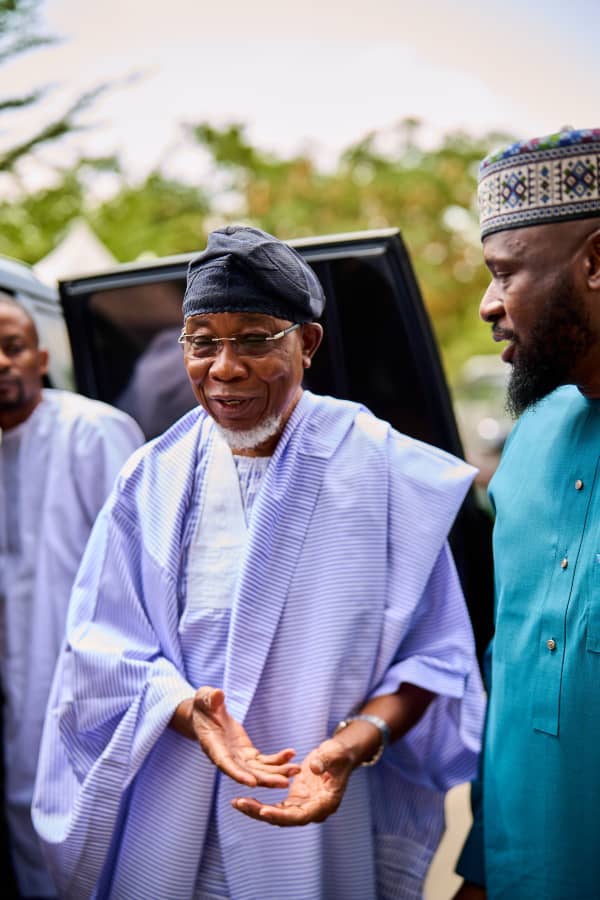

By Shaba Gbenga

In Abuja, under the charged atmosphere of a convention that felt more like a declaration of intent than routine political gathering, Rauf Aregbesola stood before party faithful and delivered a message anchored on inevitability and resistance, insisting that just as no force can halt the rising of the sun, the African Democratic Congress cannot be stopped. Speaking at the party’s 8th National Convention, he cast the ADC not merely as an opposition platform but as a movement forged in defiance, determined to confront what he described as a system defined by incompetence and drift.
He painted a stark portrait of the nation’s economy, reducing official narratives to what he implied were illusions detached from the lived reality of Nigerians. According to him, the figures speak more honestly than any government statement ever could. A currency that has fallen from about seven hundred naira to the dollar to roughly one thousand four hundred, he argued, represents not just depreciation but a complete erosion of economic stability in a country heavily dependent on imports. The ripple effects, he noted, are visible everywhere, from the soaring cost of fuel to the daily struggle of workers who now find the simple act of going to work financially burdensome. In his telling, an economy once strained is now suffocating, and the promise of renewed hope has become a refrain repeated without substance, an echo stretched across years without delivery.
Yet beyond the numbers, he directed his sharpest criticism at what he described as a troubling absence of empathy at the highest levels of leadership. He recalled moments of national grief where, in his view, presence was replaced with distance and compassion substituted with protocol. Communities struck by violence, he suggested, were left to grapple not only with loss but with the symbolism of a leadership that appeared removed from their pain. For him, these were not isolated incidents but defining examples of a deeper disconnect between the governed and those in power, a gap he warned could no longer be ignored.
He then turned to the controversy surrounding the legitimacy of the convention itself, methodically defending the processes that led to the current leadership structure within the party. He traced decisions, meetings, and resolutions, insisting that due process had been followed and acknowledged at every stage. His frustration was reserved for the electoral body, which he accused of abandoning neutrality and failing in its responsibility by refusing to monitor the convention despite formal notification. In his view, such actions were not mere administrative lapses but deliberate steps in a broader design to narrow Nigeria’s political space ahead of the next general election.
From there, his argument widened into a critique of what he described as a dangerous normalization of political manipulation. He questioned a system where, in his words, wrongdoing is increasingly shielded by law and strategy, warning that when illegality becomes a tool rather than an offence, democracy itself begins to lose meaning. Drawing from the legacy of Chief Obafemi Awolowo, he framed opposition not as an inconvenience to power but as its necessary conscience, a force meant to challenge excess and preserve balance. Without it, he cautioned, the country risks sliding quietly into a future where elections become formalities and leadership transitions resemble coronations rather than choices.
Still, his message was not without forward motion. He spoke of a party reorganizing itself from the ground up, refining its policies, strengthening its internal structures, and preparing for the contests ahead. Losses in recent elections, he admitted, had exposed weaknesses, but they had also provided lessons the party intends to build on. What emerged from his address was not a claim of perfection but a declaration of readiness, a belief that momentum is shifting and that the groundwork for a different political outcome is being laid.
As he closed, the rhythm of his speech returned to its central theme, one of courage and inevitability. The struggle, he implied, is not merely about power but about principle, not just about winning elections but about restoring direction. In that conviction, he urged those still watching from the sidelines to make a choice, warning that moments demanding clarity leave little room for neutrality. For him and for the movement he represents, standing up is no longer optional, and in that act of defiance, he placed his faith in victory, not just for a party, but for a nation he believes can still be reclaimed.